
Application Process
Find out how you can be part of the Healthier Dining Programme.
Last updated 26 March 2026
Eligibility Criteria
You are eligible to join the programme if:
Your F&B business is registered and operating in Singapore
You own more than one F&B business as part of a group that is registered and operating in Singapore, such as restaurants, food courts, caterers, etc.
Grant Application Process
HDP Application Process:
1. Application details
Estimated processing time: 3 working days
Submit your application that details your company’s profile, list of outlets and use of healthier ingredients.
You will require a CorpPass to login and access the HDP e-Services portal. All users have to be assigned the appropriate roles by your CorpPass Administrator for the application. (Please refer to Onboarding User Guide [PDF, 1.9 MB] for steps on role assignment).
For a step-by step guide to help you complete the on-line application, please refer to the following resources or email HPB_Healthy_Eating@hpb.gov.sg:
Application and submission guide [PDF, 296 KB] for Event Caterers, Free-Flow Institutional Caterers and Buffet settings
Application and submission guide [PDF, 334 KB] for all other F&B companies (e.g. Restaurants, Quick Service, Cafés, Kiosks, Chains, Bakeries, Desserts, Institutional Caterers (stalls), Digital F&B Operators)
2. Nutrition analysis
Estimated processing time: 2 weeks
HPB's Nutrition Service Provider will review your menu and identify potential menu items which can be endorsed. The Nutrition Service Provider will conduct nutrition analysis and may suggest reformulation to help you meet the nutrition guidelines.
3. Approved Menu Items
Estimated processing time: 1 week
Suitable menu items are submitted by Nutrition Service Provider for HPB’s review and approval.
4. Licence Agreement
Estimated processing time: 3 working days
Indicate your agreement to the conditions within the Licence Agreement. Submit your menu artwork within 6 months.
5. Healthier Menus/Artwork
Estimated processing time: 1 week
Submit menu artwork draft for HPB review and approval. Upon artwork approval, print and utilise artwork for publicity purposes.
What we expect from HDP Partners
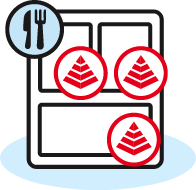
Offer 3 or more healthier food/beverage options

Follow and adhere to Nutrition and Publicity guidelines

Provide timely reports on the monthly sales information of your endorsed menu items
Nutrition and Publicity Guidelines
Nutrition Guidelines
The HDP Nutrition Guidelines [PDF, 697 KB] provide a description of nutrition requirements to qualify as a “healthier” food or beverage type
The Healthier Dining Programme Sodium Guidelines [PDF, 174 KB] provide a description of nutrition requirements to qualify as a “Lower in sodium” meal type.
The Healthier Children’s Meal Guidelines [PDF, 188 KB] provide a description of nutrition requirements to qualify as a “healthier” meal type to be served for children
Publicity Guidelines by Settings
To find out which F&B setting your company is applicable for and to view the Publicity Guidelines, please refer to the table below.
Definitions of F&B Settings & Publicity Guidelines
Restaurants
Food outlet(s) under one brand name
Air-conditioned
Typically charges GST
There is usually wait staff who will take orders and serve customers
There is a dedicated sitting area only for the restaurant’s patrons
Typically serves cuisines specific to a theme (e.g. Korean food/Salads/Western food/Mexican food)
Quick Service Restaurants (QSRs)
Food outlet(s) under one brand name
Set meals (e.g. Drink, Main, Side) are typically the default and/or main menu offering
Patrons need to queue up, pay on ordering and look for their own table to be seated
There is usually a dedicated sitting area only for the restaurant’s patrons
There are usually no GST and service charges
Food is generally prepared quickly (i.e. within 5-10 minutes)
Bakeries
Food establishment(s) that retail confectionery and baked goods
Customers usually would need to pick out bread/bun item from bread tray
There may or may not be sitting area for the patrons
There may or may not include sale of beverages
Cafés
Food and/or drink outlet(s) under one brand name whose main business is sale of beverages
Typically a limited/smaller selection of meals and desserts are offered
There is a dedicated sitting area only for the cafe’s patrons
Air-conditioned
Typically charges GST
Customers usually need to queue up, pay on ordering and look for their own table to be seated
Drink Kiosks
Drink and/or food outlet(s) under one brand name that often specializes in the sale of drinks.
Beverages sold can include freshly prepared drinks and/or specialty drinks.
There may or may not be sitting area for the patrons.
Food Kiosks
Food and/or drink outlet(s) under one brand name that often specializes in a single product category
This includes categories such as beverages, breads, sushi, meat skewers etc.
There may or may not be sitting area for the patrons
Food Courts
Food stalls are tendered to independent operators, which remain under management of one brand name
In a food court, there are multiple food and beverage vendors, as well as a common dining area for customers
Air-conditioned
Customers have to self-service meal purchase
Typically located in malls, hospitals and buildings etc
Caterers (Events)
Food and beverage businesses that deliver food in packed form or served in chafing dish with set up for customer's consumption
Consumers are required to place order in advance
Consumer can also engage the caterers to prepare food at the consumer’s premises for consumption
Caterers (Individuals)
Food and beverage businesses that provide daily meal delivery services (typically lunch or dinner, or both) for consumers for a stipulated subscription period
Meals are typically delivered in tiffin carriers or individual food containers
Consumers are required to subscribe to a plan that specifies the service period and meal plan
Institutional Caterers (Free Flow)
Food shop/stall within an institution/workplace compound
Targeted at a captive audience such as workplace canteens
Operating hours usually follows that of the institute/workplace
Dining Hall concept refers to a setting where consumers have access to extra/unlimited portions
Download Institution Caterers (Free Flow) Guidelines [PDF, 591 KB]
Institutional Caterers (Stalls)
Food shop/stall within an institution/workplace compound
Targeted at a captive audience such as workplace canteens
Operating hours usually follows that of the institute/workplace
Consumer will receive a prefixed portion from one stall
Download Institution Caterers (Stalls) Guidelines [PDF, 361 KB]
F&B Companies Operating Solely on Digital Platform(s)
Food and beverage businesses that have no physical stall front
Meal ordering based on digital website or app platform
Dessert
Food outlet(s) under one brand name that specializes in the sale of desserts
This includes categories such as local soup desserts, local and seasonal cakes, ice creams, frozen yogurts, jellies and puddings
There may or may not be sitting area for the patrons
Buffets (Restaurants/Hotels)
Typically customers pay one price and serve themselves from different stations, ranging from hot items, a salad bar, dessert stations etc.
Consumers usually have access to extra/unlimited portions, and may even cook the food (e.g. raw meat, vegetables, noodles) themselves
Offered at various places including restaurants and hotels
Coffee Shops
Coffee shops model after food courts but are typically not air-conditioned
Eating houses model after restaurants but are typically located in residential/ public housing areas, transport hubs etc
Hawkers
An aggregate of many independent food and drink stalls under one ‘centre’, with a common dining area for customers
‘Centre’ may be managed by managing agents (e.g. NTUC Foodfare/Fei Siong) or government bodies (e.g. MEWR/JTC/HDB/NEA)
Brand/Food Chain
Chain of food stalls/shops under one brand name
Majority of the outlets are usually located in food courts, coffee shops, eating houses, canteens, independent shop houses
Ready to come on board?
Email: HPB_Healthy_Eating@hpb.gov.sg