Tripartite Oversight Committee on Workplace Safety and Health
Find out more about the Tripatite Oversight Committe (TOC) on Workplace Safety and Health.
Last updated on 18 May 2026
Since its inception in 2014, the Tripartite Oversight Committee on Workplace Safety and Health (TOC) has supported employers in achieving total workplace safety and health through a holistic suite of programmes and initiatives. The third TOC term (2021-2024) started in the wake of the COVID-19 pandemic, catalysed the TOC to engage even more employers given the multi-faceted impact to employees. The TOC focused more on initiatives for individual wellbeing and offered virtual and online modalities to ensure that we continue to effectively serve the needs of different segments of our workforce.
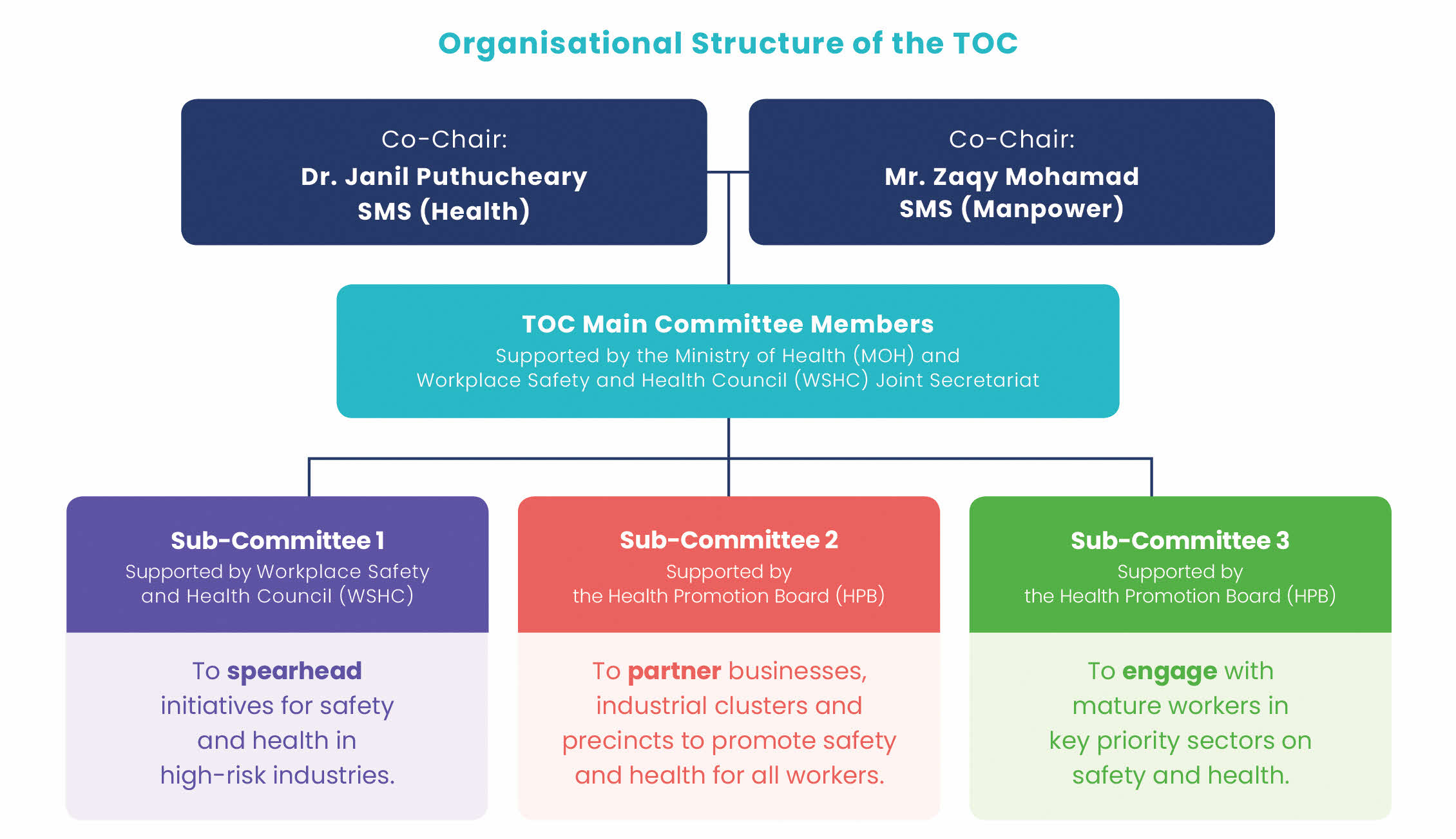
Driven by three dedicated subcommittees, the TOC focused on engaging workers in high-risk industries, business, industrial clusters and precincts, and mature workers in priority sectors, as depicted below:
In its term the committee has continued advancing workplace safety and health:
Co-Chair
Dr. Janil Puthucheary
SMS (Health)Mr. Zaqy Mohamad
SMS (Manpower)
TOC Main Committee Members
Supported by the Ministry of Health (MOH) and Workplace Safety and Health Council (WSHC) Joint Secretariat
Sub-Committees
Sub-Committee: Supported by Workplace Safety and Health Council (WSHC)
To spearhead initiatives for safety and health in high-risk industries.
Sub-Committee 2: Supported by the Health Promotion Board (HPB)
To partner businesses, industrial clusters and precincts to promote safety and health for all workers.
Sub-Committee 3: Supported by the Health Promotion Board (HPB)
To engage with mature workers in key priority sectors on safety and health.
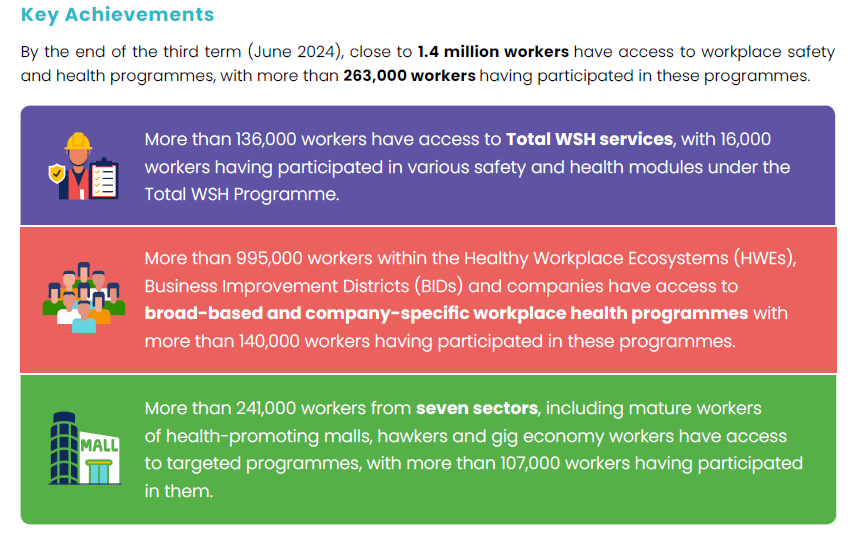
Key achievements
By the end of the third term (June 2024), close to 1.4 million workers have access to workplace safety and health programmes, with more than 263,000 workers having participated in these programmes.
More than 136,000 workers have access to Total WSH services, with 16,000 workers having participated in various safety and health modules under the Total WSH Programme.
More than 995,000 workers within the Healthy Workplace Ecosystems (HWEs), Business Improvement Districts (BIDs) and companies have access to broad-based and company-specific workplace health programmes with more than 140,000 workers having participated in these programmes.
More than 241,000 workers from seven sectors, including mature workers of health-promoting malls, hawkers and gig economy workers have access to targeted programmes, with more than 107,000 workers having participated in them.
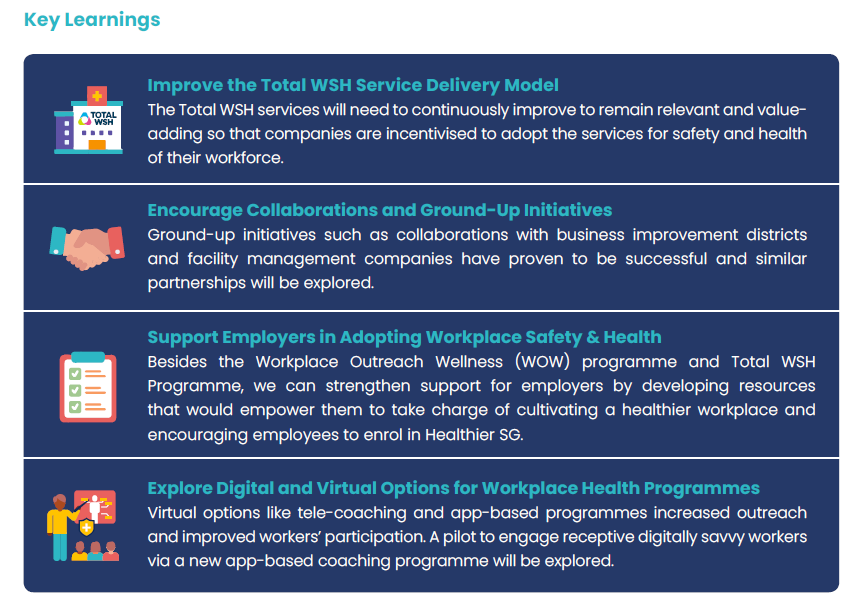
Key learnings
Improve the Total WSH Service Delivery Model
The Total WSH services will need to continuously improve to remain relevant and value-adding so that companies are incentivised to adopt the services for safety and health of their workforce.
Encourage Collaborations and Ground-Up Initiatives
Ground-up initiatives such as collaborations with business improvement districts and facility management companies have proven to be successful and similar partnerships will be explored.
Support Employers in Adopting Workplace Safety & Health
Besides the Workplace Outreach Wellness (WOW) programme and Total WSH Programme, we can strengthen support for employers by developing resources that would empower them to take charge of cultivating a healthier workplace and encouraging employees to enrol in Healthier SG.
Explore Digital and Virtual Options for Workplace Health Programmes
Virtual options like tele-coaching and app-based programmes increased outreach and improved workers’ participation. A pilot to engage receptive digitally savvy workers via a new app-based coaching programme will be explored.
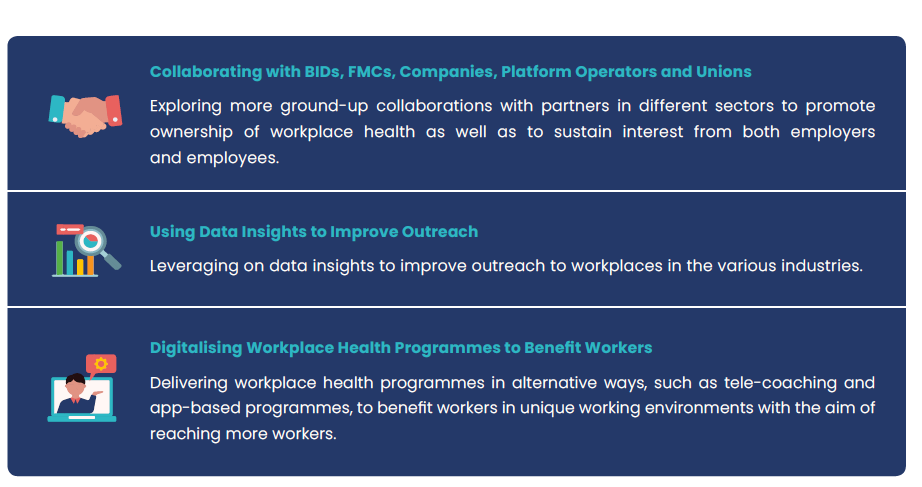
Looking ahead to the fourth term (2024-2027), the Tripartite Committee on Workplace Health will build on the strong foundations laid in previous TOC terms and oversee the implementation of these recommendations:
Collaborating with BIDs, FMCs, companies, platform operators and unions
Exploring more ground-up collaborations with partners in different sectors to promote ownership of workplace health as well as to sustain interest from both employers and employees.
Using data insights to improve outreach
Leveraging on data insights to improve outreach to workplaces in the various industries.
Digitalising workplace health programmes to benefit workers
Delivering workplace health programmes in alternative ways, such as tele-coaching and app-based programmes, to benefit workers in unique working environments with the aim of reaching more workers.
Download the full Third term report here. (opens in new tab)