
ROI Calculator
A self-help tool enabled by health economic models, the ROI calculator supports companies in estimating tangible outcomes from investing in the health of their employees.
Last updated 26 March 2026
Building the Business Case: Workplace Health Promotion Return-on-Investment Calculator

The Return-on-Investment Calculator is co-developed by HPB and health economist Dr. Joanne Yoong from the University of Southern California. It is the first public-resource tool for workplace health investment localized to Singapore’s context.
A self-help tool enabled by health economic models, the ROI calculator supports companies in estimating tangible outcomes from investing in the health of their employees. Aligned with HPB’s strategy of helping companies to quantify the benefits of workplace health initiatives, the tool offers companies a more compelling business case for adopting wider workplace health practices.
Key ways in which the calculator could be used:
Advocate health promotion efforts by highlighting the value of investing in workplace health causes and demonstrating benefits such as long-term savings from heightened productivity and a more engaged workforce.
Support value-for-money investment in health promotion by recommending workplace health programmes suited to companies' demographic profiles, and by identifying cost drivers to prompt companies to explore HPB's co-funding programmes.
Strengthens implementation of health promotion programmes by providing an evaluation of how factors such as increased participation can translate to eventual gains in health outcomes
How to use the calculator?
(The ROI Calculator is located at the end of the page.)
In this calculator, past performance and pricing are used as an indicative assumption only for the estimated projection of return-on-investment, and not a guarantee of future values. Certain calculations may require information across departments of the company. In the case where information is absent, default values derived from public health data are used as proxy.
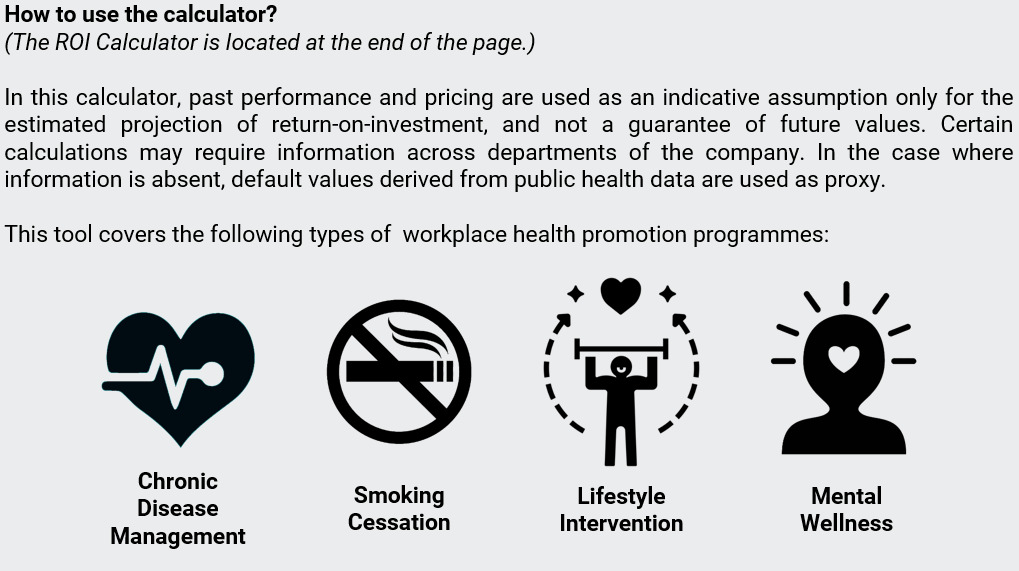
This tool covers the following types of workplace health promotion programmes:
Chronic Disease Management
Smoking Cessation
Lifestyle Intervention
Mental Wellness
Please be assured that no data is collected through the calculator at the backend.
Assumptions
These data and assumptions are drawn from pre-COVID studies and sources, and reflect existing programmes and interventions at the time. Results should be interpreted accordingly.
The model assumes a modest healthcare inflation rate, only drawing expenditures from public hospitals. Singapore Department of Statistics, Ministry of Health.
For the purposes of adjusting future cash flows to present-day values, the model assumes a standard periodic discount rate of 3%. The choice of the discount rate for costs and benefits is based on the return on risk-free government bonds, which are currently about 3% in Singapore. (Extracted from Agency for Care Effectiveness)
Future wage growth year-on-year (Extracted from Ministry of Manpower) is assumed to be similar to historical wage growth observed for Singapore over the past decade.
Citations
The following studies were used to estimate the ROI:
Average (mean) usual hours worked: Ministry of Manpower Summary Table: Hours Worked.
Average annual turnover rate: Ministry of Manpower Summary Table: Labour Turnover.
Voluntary turnover: Voluntary turnover ÷ total turnover (13.82%/19.66% = 70% for Singapore), Slide 20 of a study by Mercer.
Turnover cost: “A rule of thumb sometimes used is that is costs 50% of gross annual salary to hire a replacement.”, assumption for the Workplace Wellbeing Tool by UK Gov., Page 184.
Gross monthly wage costs (including Employer CPF): Ministry of Manpower Gross Monthly Wage Costs.
Baseline prevalence: Ministry of Manpower Summary Table.